MANAGEMENT OF INSECT PESTS
Pests in Tobacco Nursery
The pests that infest the nursery are:
(1) Caterpillars and cutworms
(2) Stem borer
(3) Whitefly
Caterpillars & Cutworms
Four species of caterpillars, viz., Spodoptera litura F., Laphygma exigua HB.,
Agrotis ypsilon Rott., and Plusia signata F., are known to infest tobacco nurseries.
Of these four species, Spodoptera litura F., commonly known as tobacco caterpillar,
is the most important pest.
Tobacco Caterpillar : Spodoptera litura F.
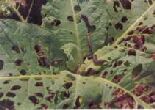
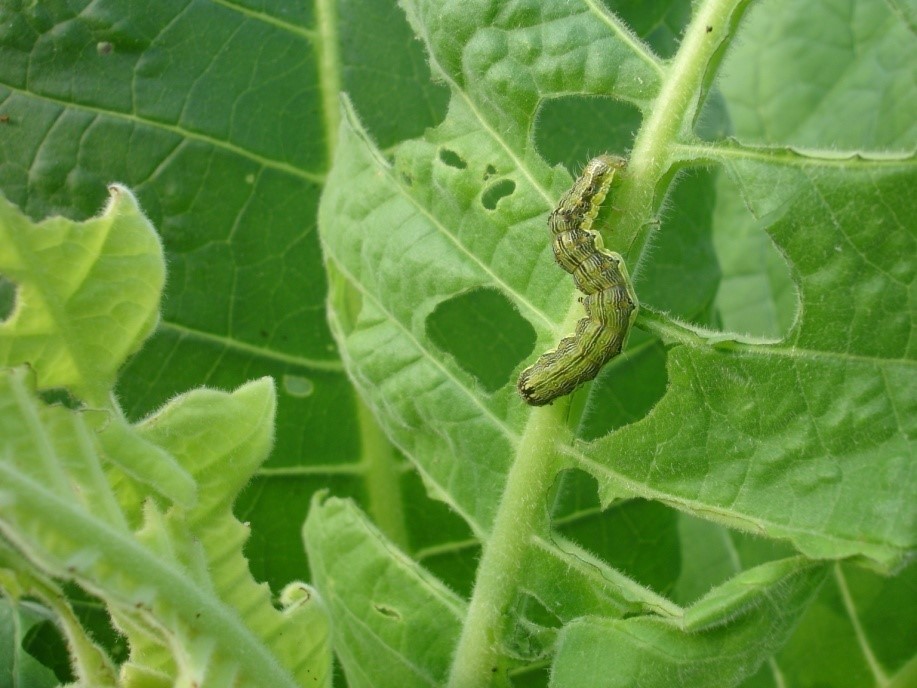
The young caterpillars are light green with black head or black spots and mine on
the leaf tissues. The well-grown caterpillars are grey or dark brown with ‘V’ shaped
white mark on the front portion of the black head. They feed voraciously along the
veins of leaves and also cut the stems of small and tender seedlings. Hence, they are
also known as cutworms. There will be about 80 to 100% loss due to this pest.
Control Measures
-
Deep ploughing of nursery area during April-May will facilitate the exposure of pupae to high temperature and thus destroy them.
-
Sowing of Castor around tobacco nursery 15 days before sowing of tobacco so that the castor puts up sufficient foliage by the time Spodoptera infestation builds up. The castor seedlings attract female moths of Spodoptera for egg laying. Leaves having egg masses and tiny caterpillars are clipped and destroyed.
-
Four 'litlure' pheromone traps are installed (loaded with 2.5 mg pheromone per vial) per acre two weeks after germination. If the catch of male Spodoptera moths is more than 5 per trap 1 % neem seed kernel suspension (NSKS) in water on 3 week old seedlings and 2% NSKS on 4 week old seedlings is to be sprayed.
For preparing 10 litres of 1% NSKS 100 gm of neem seed kernel powder is taken and placed in a small muslin cloth bag.
The bag is dipped in a bucket (or any vessel) containing 10 litres of water and the bag is squeezed for 15 minutes to obtain a light brownish liquid. This suspension can be directly sprayed on tobacco seedlings.
For preparing 2% NSKS of 10 litres, 200 gm of neem seed kernel powder is to be taken and prepared as above.
Spraying 50 litres of 1% NSKS on 3 week old seedlings and 60 litres of 2% NSKS on 4 week old seedlings or 1125 litres of nuclear polyhedrosis virus (NPV) solution prepared by 250 NPV infected larva by mixing with 250 g rice powder or starch powder during evening times or Bacillus thuringiensis var. kurstaki @ 1.0 kg in 1125 litres of water per hectare controls the pest.
If the number of seedlings damaged by Spodoptera exceeds 6 per sq.m. area spraying any one of the following insecticides from 4 weeks onwards is recommended.
(a) Emamectin benzoate 5 SG @ 5 g in 10 litres of water
(b) Novaluron 10 EC @ 10 ml in 10 litres of water.
During cyclonic weather, tobacco caterpillar, S. litura can also be controlled by putting jaggery and rice bran baits. This is prepared by dissolving 6.25 kg jaggery in 12.5 litres of water and adding to this emamectin benzoate 5 SG 200 ml. To this 25 kg rice bran is slowly added by mixing it thoroughly with a smooth stick so that the bait is made into small balls. The bait is broadcasted on the nursery beds during evening hours to effectively control the caterpillars.
The other 3 species of caterpillars viz., (1) green caterpillar, L. exigua (2) green looper P. signata and (3) black caterpillar, A. ypsilon that sometimes infest the tobacco nurseries can also be controlled by spraying any one of the above insecticides.
Stem borer
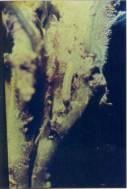
The stem borer is the larva of a tiny brown moth called Scrobipalpa (Gnorimoschema) heliopa Low. The tiny caterpillars bore inside the stem and midribs and feed on internal tissues. As a result swelling appears where the borer stays.Borer infested seedlings when planted in the field remain stunted and some times unusual branching of the plant is seen.
Control Measures
-
Stem borer affected seedlings should be removed and destroyed.
-
In tobacco nurseries when stem borer is a serious problem, spraying of Flubendiamide 48 SC @ 2.5 ml or chlorantriniliprole 18.5 SC @ 3 ml in 10 litres of water at 40 and 55 days after germination is taken up. Final spray of one of these insecticides should be given before pulling seedlings.
-
In planted crop above insecticide is sprayed twice or thrice at 10 days interval starting from 15 days after planting. After completion of harvestings the stem borer affected plants are uprooted and burnt to prevent carry over of the pest to the next season.
Whitefly: Bemisia tabaci Gennadius
White flies are small fly like insects seen on the underside of leaves. They will fly immediately when the plant is disturbed. The adult fly sucks the sap from leaves and transmits the leaf curl virus disease from infected to healthy seedlings.
Control Measures
-
Alternate weed hosts around nursery area are removed and destroyed.
-
Yellow-sticky traps (20 cm x 15 cm size galvanized iron sheet painted with yellow colour coated with castor oil) are installed @ 5 per acre.
-
If the population of whitefly is 100 per each sticky trap, the following insecticides may be sprayed at 10 days interval commencing from 4 weeks after germination.
-
Imidacloprid 200 S.L. @ 2.5 ml in 10 litres of water.
-
Thiamethoxam 25 WG @ 2gm (or) pymetrozine 50 WG @ 4 g (or) flonicamid 50 WG @ 4g in 10 lit of water.
PESTS IN THE PLANTED CROP
The major pests that affect tobacco crop in the field are whitefly, leaf eating caterpillars, tobacco aphid/green peach aphid and capsule borer. Control measures for these major pests are detailed below.
Leaf eating caterpillar : Spodoptera litura F
In the field crop the pest incidence is generally confined to few border rows. The female moth lays about 2000 eggs on the either side of the leaves in bunches. After 2-3 days of incubation light green tiny caterpillars with black head emerge in hundreds. They eat the green matter of the leaf and turn to grey or dark grey or black in colour. The grown up larva feed voraciously on the tobacco leaf making lot of holes on the leaf causing damage to an extent of 10 to 15%.
Ten pheromone traps per ha are installed 20 days after planting. The leaf is critically examined for egg masses and tiny caterpillars which are later collected and destroyed. If the infestation is severe, the hot spots are sprayed thoroughly with 0.5% neem seed kernel suspension or nuclear polyhedrosis virus 250 LE in 1125 litres of water per ha by mixing with 250g rice powder or starch powder or any one of the following insecticides.
a. Emamectin benzoate 5 SG @ 5 g in 10 litres of water.
b. Novaluron 10 EC @ 10 ml in 10 litres of water
Whitefly : Bemisia tabaci Gennadius
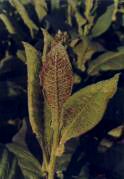
These tiny white flies cause leaf curl disease. The leaves of curled plants are twisted, puckered and thickened with abnormally prominent veins. The plants show stunted growth and the yields are reduced.
Control Measures
-
Leaf curl affected seedlings are to be avoided while transplanting in the field.
-
Alternate weed hosts are to be removed and destroyed.
-
Crops like brinjal and sunflower should not be grown in the vicinity of tobacco fields.
-
If the population of leaf curl infested plants is less than 2% within one month after planting, they are removed and destroyed.
-
Twelve yellow sticky (castor oil coated) traps per hectare are installed to monitor the white fly population.
-
If the whitefly population is heavy the spray schedule recommended for the nursery has to be adopted in the field crop also commencing from 10 days after planting at an interval of 15.
Spraying is done preferably in the evening hours (4 to 6 pm) with high volume sprayers ensuring that the both sides of leaves are covered. Further, the spraying schedule has to be adopted by all the tobacco farming community in the endemic area. Spraying should be given 10 days after planting.
Tobacco aphid : Myzus nicotianae Blackman
Green peach aphid: Myzus persicae Sulz
Aphids are louse like insects which are green or pinkish to brown in colour. In case of heavy infestation hundreds of them can be seen on the underside of leaves. By constantly sucking the sap from leaves they make the plant pale and sickly and thereby retard the growth. They secrete sugary juice known as 'honey dew' on the leaves due to which sooty mould develops rendering the leaves unfit for curing. In addition they also transmit virus diseases like rosette or bushy top.
Control Measures
-
During early winter, for control of aphids when 2% of the plants are infected,
any one of the following insecticides is sprayed once.
- (or)
-
Imidacloprid 200 SL @ 2.5 ml (or) thiamethoxam 25 WG @ 2 g (or)
pymetrozine 50 WG @ 4 g (or) flonicamid 50 WG @ 4 g in 10 litres of water.
If the infestation is still observed later, spraying is to be done only on aphid infested plants once in 8-10 days. A gap of one week is left between spray and harvesting of leaf to avoid excess pesticide residues in cured leaf. If more than one spray is required the insecticide is changed.
Capsule borer : Heliothis armigera Hb
The larvae of this species are greenish or pale brown with broken dark-brown stripes along the body. They bore the capsules and feed on the seeds inside. They feed on top leaves also when the infestation is heavy.
The incidence of capsule borer is observed during grand growth phase of the crop under favourable conditions, preferably after heavy rains in untopped fields. The incidence is seen from 30 days after planting. Generally one larva is seen on the terminal bud. Between 30 - 50 days it feeds on the terminal bud and then on the young leaves and causes loss to the crop. More than one borer per plant are seen after the flowering and then it feeds on the developing seed of the capsules.
Control Measures
-
Hand picking of the bud worm/capsule borers in the tobacco crop once in three to four days and destroying. Care should be taken to avoid touching the TMV infected plants.
-
Flower heads are topped or trimmed to bring down the incidence of capsule borer considerably.
-
In untopped fields flubendiamide 48 SC @ 2.5ml or chlorantranaliprole 18.5 SC @ 3 ml in 10 liters of water or nuclear polyhedrosis virus (NPV) of Heliothis @ 250 LE or Bacillus thuringiensis var. kurstaki @ 1.5 kg in 1125 litres of water per hectare is sprayed. For NPV solution strach power @ 250 mg per ha is added and sprayed in evening hours.
Care to be taken while using pesticide
There are strict regulations regarding the pesticide residues in tobacco through out the world. The residues must be within the prescribed limit. In all the tobacco growing countries DDT and other chlorinated hydrocarbon pesticides (except endosulphan) are banned for use on tobacco. Pesticides should not be used indiscriminately. The following are the recommended and banned pesticides on tobacco.
Emamectin benzoate
Monocrotophos
Chlorantraniliprole
Phosphamidon
Neem seed kernel suspension
Dieldrin
Pongamia cake powder
DDT, Oxydemeton-methyl
Neem cake powder
Profenophos
Nuclear polyhedrosis virus solution
Parathion dust, BHC
Bacillus thuringiensis var. kurstaki
Endosulfan dust etc.
-
Recommended pesticides should only be used on tobacco. The banned pesticides should not be used under any circumstances.
-
The pesticides should be in the recommended doses and when there is a need. Using more than the required times should be avoided.
-
The pesticides in dust form should not be used on tobacco.
-
When number of pesticides are recommended for controlling a single pest and when there is need to spray more number of times, the pesticide should be changed each time.
-
The banned pesticides on tobacco should not be sprayed even on rotation crops or other crops in the surrounding areas.
-
Cikar sprayers with duromist nozzles or high-tech sprayers should be used for better efficacy.


 Government of India
 || Ministry of Agriculture & Farmers Welfare